

spill the tea!
- on vanishing public spaces

I met a friend on Thursday who was visiting my city for the first time. On our way home, he remarked that there are not many ‘tapris’ in Delhi. I told him that we had plenty of roadside tea stalls here, but he told me that it is more than just drinking tea and going about your way. It involves a nice place to sit, and even better opportunities for conversation. What he essentially pointed out was the lack of public spaces in fast cities like Delhi.
This sent me down an Internet rabbit hole. I came across a paper where 1Banerjee (2001) reflects upon the diminishing system of public parks in America. However, the concepts he has touched upon stand true for all urban spaces today. Our public experience is becoming privatised due to more market control than State control over resources. Keeping this in mind, what intrigued me was the explanation about Disneyland. Hyperreality, as Umberto Eco observes, is the driving factor in creating the world at Disneyland. This is because it dissolves the distinction between itself and our mundane realities. The break that it offers from the latter is so stimulating that its version of reality seems more realistic than ours. In tandem with this, there is a very clear demarcation between those who can and cannot afford this. We live in gated communities, which, while enforcing cultural assimilation, also protect us from ‘undesirable’ social elements like the poor and the marginalized. Indeed, they also create a general sense of security against criminal activities and the like. At the same time, there is a growing space that social media occupies in our lives. Remaining in our cyberspaces seems more comfortable than actually interacting in physical spaces.
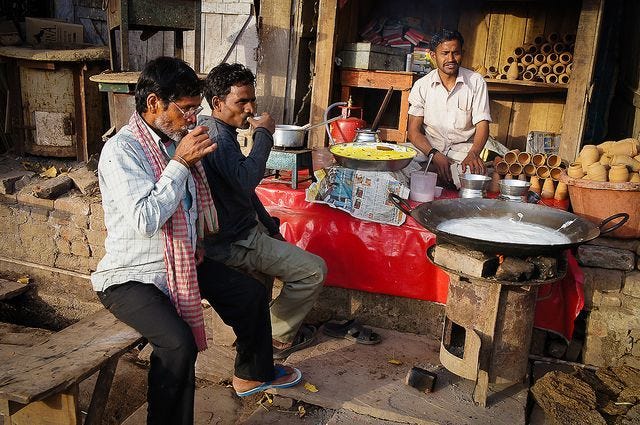
From a layman’s perspective, I would like to add that leisurely public spaces like tapris and parks are also less and less prevalent because of the momentum of our lives. I can at least say this for Delhi: it seems like the city is always on the move. Roads are brimming with vehicles and more vehicles, regardless of what hour of the day it is. We are either going somewhere or coming somewhere with a checklist in our heads.
There is a definitive rise in third places, which, according to Ray Oldenberg, are spaces where people can socialize beyond their home and work spaces. These include cafes, bars, beauty salons, and more. 2Pine and Gilmore (1999) categorise them within the “experience economy”, which is driven by consumerism. Shopping malls, department stores, and the like, today, Banerjee (2001) argues, are created to encourage people to ‘hang out’. He uses the term ‘invented streets’ in the Western world that are supposed to act as catalysts for the same. Third places like these also create grounds for engaging in flanerie, i.e., the act of walking around and observing. Coming closer to my life for a bit, as someone who loves to do cafe-hopping, the number of times I have interacted with a stranger is a grand total of 1. I must agree, though, that it is easier to talk to someone in a cafe or a beauty salon than in a mall. I can especially attest to the sociable quality of the latter because I have interacted with the lady who does my waxing every time (to distract myself from the pain), and even with the woman who owns the salon. It is nice. Observing is nice, but how much are we truly observing? How much time do we have? All cafes somehow look the same and boast of a European vibe. I love those quaint spaces which are never quaint, but I am tired of looking at the same things in this context.


Coming back to my friend’s point about ‘tapri’ culture, he was focusing on conversations that grow beyond small talk. That does not happen often, at least in my immediate surroundings. This point is also labored upon by 3Lisa Peattie (1998) in her concept of convivality. This, she argues, goes beyond mere feasting and having a ‘good time’, since it involves creative discourse amongst each other and with the environment. That is, “small-group rituals and social bonding” translated to “serious collective action from […] neighborhood cleanups to civil disobedience […]”. If I look closer at Peattie’s vision, then it seems that she is envisaging a more direct relation among people and with their environment. You learn about each other, and you become sensitive to your surroundings. I do see this happening on social media, which is a step in the right direction, but I worry that the echo chamber gets so loud and opinionated that it becomes difficult to process some of the major environmental and political issues that plague us today. There is news about wreckage in some part of the world and a reel specialising in brain rot, so you see what I mean. The world must exist beyond a phone screen, or at least we could reach a balance, perhaps.
However, hope is not lost because today I came across this news about New York, where workers protested against the Met Gala by staging their own “Ball without Billionaires”. This was done to highlight how billionaires like Jeff Bezos have millions for the Costume Institute while remaining aloof from ensuring safer and equitable working conditions for their employees. No outfit was bought from Amazon, and all of them were designed by immigrants. Now, that is good news!

As I pointed out before, there are several reasons for the lack of community. From a personal standpoint, I think that those factors are creating a growing sense of apathy and loneliness amongst us. I long for conversations, and sometimes walking in malls feels like I am walking on glass, round and round. Window shopping takes up half of my time, and my flanerie is limited to observing in a limited space. There is meaning around me, and also not. Every interaction of mine is planned, and it does seem like social media is the only way left to connect and meet new people. I am tired of scrolling, too. I do not need a million friends, but I like spontaneous conversations. There is life to be lived and caught up with, personal troubles to iron out, and petty jealousies to deal with. How do I find the time to engage in a conversation on a tapri or even meaningfully observe the world around me without cussing twice at the traffic?
Banerjee, Tridib. “The future of public space: beyond invented streets and reinvented places”. (2001)
Pine, J. B., & Gilmore, J.H. “The experience economy: Work is theatre and every business a stage.” Harvard Business School. (1999)
Peattie, L. Cities for citizens: Planning and the rise of civil society in a global age. (1998)
I think this is one of the reasons a lot of people turn to places like Substack, in search of online tapris! Can't tell if that's a good thing or not yet. Regardless, this was a wonderful read.
I absolutely love the fact that whenever I click on a notification from Lilac, I never know what I am opening. It could be a raw emotional punch packed into a poem, an interview, a very personal blog piece, or just something nuanced like this. In the words of Rocky the Eridian: 'Amaze. Amaze. Amaze. 🙌